Best UK Sportsbooks for MLB Props: Regulated Operators
 Available in US
Table of Contents
Available MLB Prop Markets at UK Sportsbooks
When I first started looking for MLB player props on UK sportsbooks back in 2017, the cupboard was nearly bare. Most licensed operators listed moneyline and match totals for marquee games and nothing else. No strikeout props, no home run markets, no total bases. If you wanted to bet on individual player performances in baseball, you needed an account with an offshore platform or an American-facing book — neither of which is a comfortable option for a UK-based punter who values regulatory protection.
That landscape has shifted meaningfully. MLB has been actively expanding its international footprint, staging regular-season games in London, Seoul and Mexico City. International markets now contribute roughly 10-15% of the league’s total revenue through broadcast deals and merchandise. As MLB’s global profile has grown, so has UK sportsbook interest in offering deeper baseball markets. The 47% of UK adults who participate in some form of gambling represent a large addressable market, and operators are gradually realising that a subset of those punters — particularly younger demographics comfortable with American sports through streaming and social media — want access to MLB props.
The growth is real, but the gap between what is available on UK platforms and what American bettors access remains significant. Understanding that gap, and knowing how to work within it, is the practical focus of this guide. I will cover which UK books carry MLB player props, how to read the odds formats you will encounter, the regulatory rules that directly affect your MLB prop betting experience, and the market-depth differences that shape your strategy from this side of the Atlantic.
The US sports betting market reached $16.96 billion in revenue in 2025 — a record — and Americans legally wagered $166.94 billion on sports that year, an 11% increase over 2024. That enormous market has driven massive investment in MLB prop infrastructure: real-time odds engines, player-level trading models, and deep prop menus covering dozens of markets per game. UK operators are tapping into that infrastructure gradually, and the MLB prop landscape available to British punters today is broader and more competitive than it was even two years ago. The question is not whether MLB props are available in the UK — they are. The question is how to extract maximum value from what is on offer while navigating a regulatory environment that is uniquely British.
Which UK Sportsbooks Carry MLB Player Props
Coverage varies more than you might expect, and it changes season to season as operators adjust their market offerings. Rather than providing a list that will be outdated within months, I want to give you a framework for evaluating coverage yourself — because the specifics shift, but the principles stay constant.
The large multinational operators licensed by the UK Gambling Commission tend to offer the broadest MLB prop menus. These platforms have the trading infrastructure and the US-facing sister brands that allow them to mirror American prop markets for their UK customers. On a full-schedule day with 15 games, the best UK books might list strikeout props, home run props, total bases, hits, and occasionally earned runs for starting pitchers across 10-12 of those games. On lighter schedules or afternoon-only slates, coverage thins.
Mid-tier UK operators — the ones focused primarily on football and horse racing — typically offer fewer MLB prop markets. You might find basic moneyline and game totals but no player props at all, or player props only for nationally televised US games. If you are serious about MLB prop betting, these books are useful for line-shopping on the markets they do cover but cannot serve as your primary platform.
FanDuel and DraftKings together control approximately 72.3% of the regulated US betting handle, and their market-making operations set the pricing tone for MLB props globally. UK books that source their odds from major international trading feeds will often reflect similar pricing structures, though the decimal odds format and the vig structure may differ slightly. Checking three or four UK-licensed operators before each bet is not optional — it is essential. I have found pricing discrepancies of 0.10 to 0.20 in decimal odds on the same MLB prop across UK books on the same evening. Over a season of 200-plus bets, those discrepancies are the difference between a profitable year and a flat one.
Timing matters too. Some UK books post MLB props early in the morning, well before US lineups are confirmed. Others wait until lineups lock, typically 3-5 hours before first pitch. Early lines carry opportunity and risk in equal measure — you might grab value before the market adjusts to a weak lineup, or you might get caught by a late scratch that reshapes the prop’s probability.
My workflow has settled into a consistent rhythm after years of refinement. I check for early lines around midday UK time, noting any obvious value candidates but not betting yet. Once lineups are confirmed — usually between 4:00 PM and 6:00 PM UK time for evening games — I run my full analysis and place bets across whichever UK platform offers the best price. For West Coast games starting after midnight UK time, I complete my research by 10:00 PM and set my bets before the late-night lines move. This schedule sounds demanding, but the MLB season runs April through October, and the 162-game calendar provides a steady flow of opportunities without requiring the same game-by-game urgency that football offers on weekend slates.
Reading Decimal and Fractional Odds on MLB Props
If you have grown up betting on Premier League football, the odds formats on your screen are already familiar. But applying them to MLB props requires a slight mental adjustment because the probability ranges are different from what you are used to in football markets.
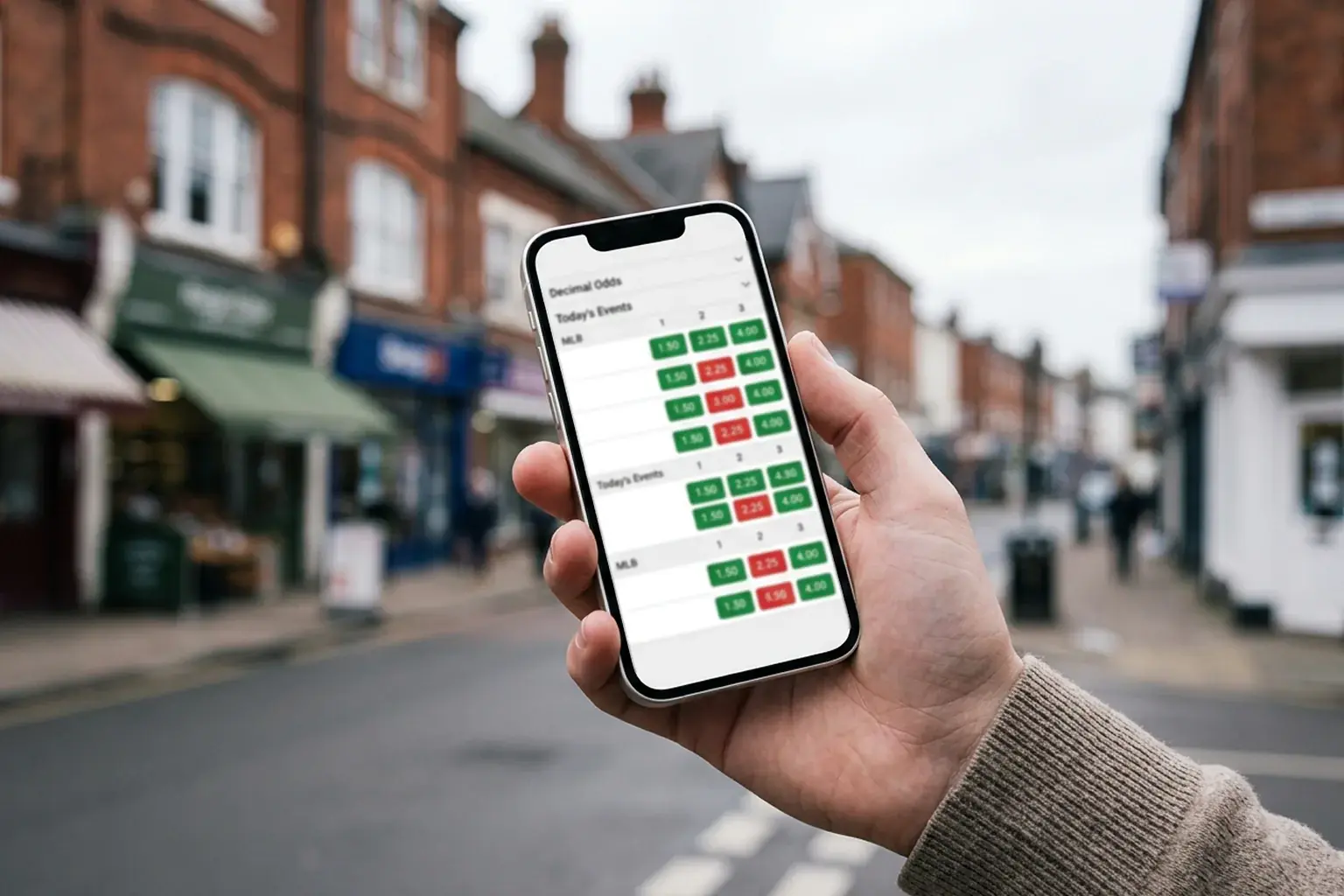
Decimal odds tell you the total return per unit staked, including your original stake. Odds of 1.85 mean a one-pound bet returns 1.85 pounds if it wins — 0.85 pounds profit plus your original pound back. The implied probability is 1 divided by 1.85, which equals 54.05%. For most MLB prop overs and unders, you will see decimal odds in the 1.70 to 2.10 range, implying probabilities between roughly 48% and 59%. Home run anytime props sit further out, typically 3.00 to 6.00, implying probabilities between 17% and 33%.
Fractional odds — still the default on some UK platforms — express the profit relative to the stake. Odds of 5/6 mean you win five pounds for every six staked. The implied probability is 6 divided by (5 + 6), or 54.5%. Fractional odds become cumbersome at non-standard values, which is partly why most serious bettors switch to decimal. If your book defaults to fractional, check the settings — nearly all UK operators offer a decimal toggle.
American odds (-110, +150) are the standard on US platforms and occasionally appear in MLB-specific content from American analysts. Negative American odds indicate the stake required to win 100 units; positive odds indicate the profit on a 100-unit stake. Converting American to decimal is straightforward: for negative odds, divide 100 by the absolute value and add 1 (so -110 becomes 1.909). For positive odds, divide the odds by 100 and add 1 (so +150 becomes 2.50). I encounter American odds constantly in my research workflow — every FanGraphs or Baseball Savant article uses them — so being fluent across all three formats saves time and prevents errors.
The key habit is always converting to implied probability before assessing value. The odds format is just a wrapper. What matters is whether the implied probability is lower than your estimated true probability. Train yourself to see past the format and think in probabilities, and the expected value guide walks through exactly how to run that comparison step by step.
One practical tip that saves me time every evening: I keep a simple conversion reference pinned to my desk. Decimal 1.80 = 55.6% implied. Decimal 2.00 = 50.0%. Decimal 2.50 = 40.0%. Decimal 3.00 = 33.3%. Decimal 4.00 = 25.0%. After a few weeks of checking these numbers regularly, the conversions become automatic and you stop needing the reference. But until then, having it visible prevents the kind of mental arithmetic errors that lead to miscalculated edges — particularly late in the evening when you are assessing props for games starting at 1:00 AM UK time.
UK Gambling Commission Rules That Affect Your Prop Betting
The UK regulatory environment is tighter than what American bettors experience, and it is getting tighter still. Several recent changes directly impact how you bet MLB props from the UK, and ignoring them can lead to account restrictions, delayed withdrawals, or unpleasant surprises at the worst possible moment.
The most consequential shift is the introduction of the statutory gambling levy in April 2025, replacing the old voluntary model. This levy requires UK-licensed operators to pay a mandatory tax that funds research, prevention and treatment of gambling harm. The first invoices were issued in September 2025. On top of this, the duty on remote gambling is set to increase from 21% to 40% for online casino products and from 15% to 25% for online sports betting from April 2027. These cost increases flow through to operators, and operators will recoup them somewhere — either through wider vig on prop lines, reduced promotional offers, or thinner market coverage on niche sports like baseball.
For punters, the immediate practical impact is that UK MLB prop odds may gradually become less competitive compared to markets in jurisdictions with lighter tax burdens. Line-shopping across multiple UK books becomes even more important as operators adjust margins differently. I have already noticed subtle widening of the vig on some baseball prop markets on two UK platforms in 2026 compared to 2025. The shifts are small — 0.03 to 0.05 in decimal odds — but over hundreds of bets they erode your expected return.
The levy also reshapes operator incentives. Books that previously offered MLB props as a loss-leader to attract American-sports bettors may reduce coverage if the margins on those markets do not justify the additional regulatory cost. Conversely, operators that see baseball as a growth market may absorb the cost and maintain competitive pricing to capture market share. Watching how individual operators respond to the new tax regime over the coming seasons is part of the due diligence of being a serious UK-based MLB prop bettor.
Online stake limits arrived in April 2025 as well. For online slots, the caps are five pounds per spin for those aged 25 and over and two pounds per spin for 18-to-24-year-olds. These limits apply to slots specifically, not to sports betting props. But the regulatory direction is clear — the Gambling Commission is willing to impose hard limits on staking to protect consumers, and expansion to other product categories is not off the table.
Financial Vulnerability Checks and Stake Limits
Since 28 February 2025, UK operators have been required to conduct financial vulnerability checks on customers whose net spending exceeds 150 pounds within any 30-day period. The checks are designed to identify signs of financial distress — betting beyond means, patterns associated with problem gambling. If triggered, the operator may request additional documentation (proof of income, bank statements) or restrict your account until the check is completed.
For active MLB prop bettors, this threshold can be reached quickly. A punter placing two or three prop bets per day at 10-20 pounds per bet will cross 150 pounds in net spend within a couple of weeks, even if many of those bets are winners. The checks are not punitive — they are a consumer protection measure — but they can be disruptive if you are not expecting them. My advice: maintain records of your betting activity and be prepared to respond promptly if your operator requests information. Delays in responding can lead to prolonged account restrictions. I keep a running spreadsheet of all bets placed, stakes and results — not just for analytical purposes, but so I have a ready answer if an operator asks for context on my activity.
The broader context is sobering. Research from the House of Lords Gambling Industry Committee found that 60% of gambling industry profits come from just 5% of customers — those who are problem gamblers or at risk of becoming one. The financial vulnerability checks are a direct response to that statistic. The UK government has allocated 100 million pounds through the new levy toward gambling harm prevention and treatment, distributed across the Office for Health Improvement and Disparities, UK Research and Innovation, and NHS England. The regulatory framework is designed to protect you, and while the checks add friction, they exist for a reason.
Comparing Market Depth: UK vs US Prop Availability
The gap between UK and US prop availability is real, and pretending otherwise would be dishonest. American bettors in legal states — 38 states and the District of Columbia now offer legal sports betting — can access MLB player props across dozens of markets on any given game: strikeouts, hits, total bases, home runs, RBIs, runs scored, stolen bases, walks, earned runs, outs recorded, and even pitch-level micro-props. UK books cover a fraction of that menu.
On a typical evening with 10-12 MLB games, the best UK sportsbooks might offer player props on 8-10 of those games, covering the most liquid markets: strikeout over/under, home run anytime, total bases, and sometimes hits. Earned runs, walks, stolen bases and combo props (H+R+RBI) appear less consistently. Pitch-level micro-props — bets on individual pitches like ball or strike, hit or out — are largely absent from UK platforms, partly because of the integrity concerns highlighted by the Clase/Ortiz scandal and the subsequent $200 stake cap imposed by MLB.
The thinner menu is a constraint, but it is not necessarily a disadvantage. Fewer markets mean you can focus your research more tightly. Instead of spreading your attention across 15 prop types per game, you concentrate on the 3-4 markets available and develop deep expertise in each. I have found that my hit rate on UK-available props is higher than on the broader US menu precisely because I am not tempted by marginal markets that look interesting but offer thin edges.
There is a strategic benefit to the constraint as well. Because UK books offer fewer MLB prop markets, the ones they do list tend to be the most liquid and most well-traded — strikeouts, home runs, total bases. These are exactly the markets where publicly available Statcast data provides the richest analytical foundation. The niche markets absent from UK platforms — pitch-level props, walks, stolen bases — are often the ones where data is thinnest and variance is highest. By default, the UK menu steers you toward the markets where a data-driven approach has the greatest chance of producing sustainable returns.
One workaround for punters who want access to broader markets: some UK-licensed operators with international presence offer expanded MLB menus through their global platforms. Be cautious here — ensure any platform you use holds a valid UK Gambling Commission licence. Betting through unlicensed offshore operators strips you of consumer protections including dispute resolution, responsible gambling tools, and the assurance that your funds are segregated and protected.
The trajectory is encouraging. As MLB continues its international expansion and UK demand for baseball content grows through streaming services and social media, operators will follow the money. Max Bichsel of the Gambling.com Group described the convergence of sports, media and betting as a once-in-a-lifetime event, and the UK market sits at the intersection of all three trends. Market depth on UK sportsbooks has expanded meaningfully each season since 2022, and I expect that trend to continue. What matters today is maximising the edge within the markets currently available, not waiting for the menu to catch up.
UK Sportsbooks and MLB Props: Questions Answered
What verification documents do UK sportsbooks require to open an MLB prop betting account?
UK-licensed sportsbooks require identity verification (passport or driving licence) and proof of address (utility bill or bank statement dated within the last three months). Some operators also request proof of funds or source of income, particularly if your net spend exceeds 150 pounds within 30 days, triggering financial vulnerability checks. The process is standard across all UK Gambling Commission licensees and applies equally to MLB prop betting and any other market.
Do UK sportsbooks offer the same range of MLB prop markets as American operators?
No. UK platforms offer a subset of the markets available in the US. The most common MLB props on UK books are strikeout over/under, home run anytime, total bases and hits. Less common are earned runs, walks, stolen bases and combo props. Pitch-level micro-props are largely unavailable. Coverage also varies by game — marquee matchups receive broader prop menus than afternoon or mid-week games.
How do financial vulnerability checks affect high-volume MLB prop bettors in the UK?
Financial vulnerability checks are triggered when your net spending exceeds 150 pounds within a 30-day period. For active prop bettors placing multiple bets per day, this threshold can be reached within two weeks. When triggered, the operator may request proof of income or bank statements. Responding promptly minimises disruption. The checks are a regulatory requirement, not a punitive measure, and apply to all UK-licensed operators regardless of the sport you are betting on.
Which UK bookmaker typically has the best odds on MLB strikeout props?
No single bookmaker consistently offers the best odds across all MLB prop markets. The operators with the broadest MLB coverage tend to be the larger multinational platforms with US-facing brands that allow them to mirror American pricing. The most effective approach is to maintain accounts across three or four UK-licensed books and compare prices before each bet. Discrepancies of 0.10 to 0.20 in decimal odds on the same prop are common and compound meaningfully over a full season.
Created by the ”mlb bet Props” editorial team.